

Banned Books: "The Absolutely True Diary of a Part-time Indian"

Welcome to "A Fleeting Thought" where I post relatively short and to the point book reviews and share my bookish thoughts!
It is Banned Books Week and I've been posting on my Instagram about my thoughts. Today I posted about "The Absolutely True Diary of a Part-time Indian" (which I will be shortening to "The Absolutely True Diary (which is still not that short)) and why it is a banned book, but I wanted to expand (and complain) more about it here!
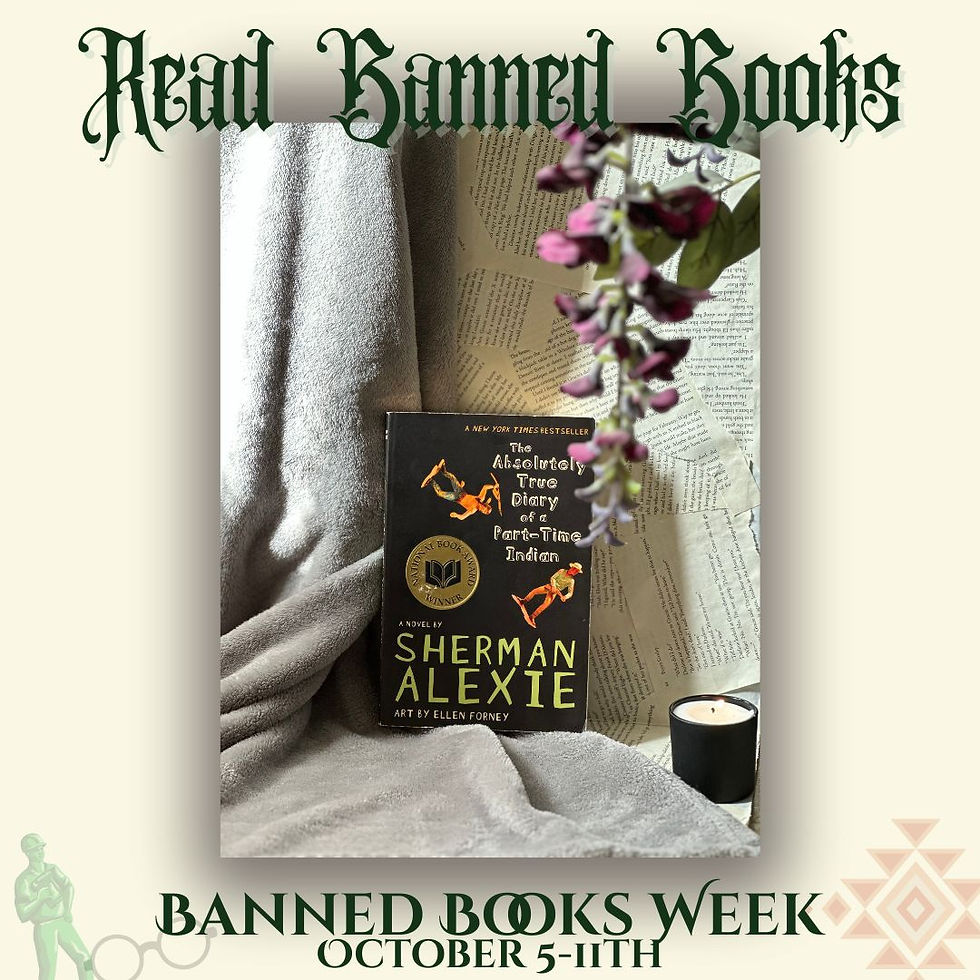
"The Absolutely True Dairy" is a young adult (YA) novel that follows a 14 year old boy navigating life on the rez. He's discovering bullying, alienation, his own sexuality, grief, racism. All the things we unfortunately see on the daily in the US. Since this book is YA and follows a 14 year old, it explores things that are very normal for a 14 year old. Therefore, it many teachers thought it appropriate to read to 9th grade students. It would be able to stimulate discussion on otherwise taboo topics. According to data from Marshall University, this book has been challenged since 2009.
Why is "The Absolutely True Diary" banned or challenged?
Profanity and vulgar language
In the novel, a racist joke is made and the character uses the N-word. I think we can all agree we shouldn't be using that word, especially with a hard R. But there are instances where it is contextually appropriate within to confines of literature to use that word in order to display the level of racism one character is exhibiting or experiencing. To put our hands over our ears and say "la la la" and pretend that word still isn't used in a derogatory way by (unfortunately) many people is plain ignorant.
When it comes to profanity, the last place they're getting it from is book. They're getting it from the YouTube videos you allow them to watch unsupervised, the movies they sneak at sleepovers, and most often the parents themselves.
Sexual references
A fourteen year old boy discovered he had a penis, therefore discovering masturbation. Oh, the horror! The level of sexual taboo and the pious rhetoric around it is extremely harmful to so many people. Masturbation is normal and it is healthy. Now, some of the ways we consume sexual content is not healthy. But masturbation shouldn't be taboo. You know if you're discussing this book with 9th or 10th graders, those little fucks definitely know a thing or two about sex. And, they usually find out about it from peers (which are unreliable and uneducated sources) or porn (which is unrealistic, dangerous to the psyche-- especially with overconsumption-- and sets a harmful standard about how individuals should treat each other during intercourse).
Having the discussion that it is a: normal, we shouldn't be pressuring individuals, we shouldn't be worried about other peoples private bits, and it's b: okay to hump your pillow is important. Kids will find a way to learn about this shit whether we want them to or not. It is important to not put shame around sex or masturbation. It is important to create an open and safe line of communication so our children don't involve themselves in dangerous scenarios in the name of curiosity. Removing literature that references sex or masturbation won't get rid of it. It's also important to note that discussing sex doesn't promote sex.
Mentions of violence, bullying, racism. All things that happen daily all over the world, but especially in the US.
It's like the US is allergic to the reality of the problems it has. Problems that are largely fixable, mind you, if we put our money and resources toward them. Are we afraid of the racism in this book? The acknowledgement that he was rejected from his own tribe for trying to get a better education and rejected from the new people he was now around. The racism he experienced, the beating for being different, the slurs hurled at him just for looking different, those aren't singular and they aren't, by any means, uncommon. Books like "The Absolutely True Diary" show how someone was singled out just for existing. Books like this can teach and show empathy and compassion. Two very important, but seemingly lacking, feelings.
The first noted challenge of this book according to Marshall University was by a singular parent in 2009. They claimed the book was offensive. What I don't understand is how one person get to dictate and deem what is offensive for an entire class. Why is one persons personal preference being held over everyone else?
Some schools here in Cheyenne, WY, where I currently live, have offered a paper to send home to the parents where the parents can give their permission for how much access their child has to. the library. While I still think it's asinine, I think that's the best (worst) way to do it. If you don't want your child to be exposed to books, fine. I disagree, but fine. But your views certainly should not be pushed on to others and it definitely should not be taking away from others.

I reiterate what I said in my last post, and I'll continue to say this until I'm dead. I believe books are the safest places to learn about the scariest things. In a book, you can explore what a life looks like and the dangers of substance abuse. You can recognize damaging patters between family. You can learn what grooming and SA are. You can recognize negative patterns in books and hopefully turn around and keep that negativity out of your life. You can learn to protect yourself from dangerous situations because you've seen it play out in books.
The boards deciding what should be allowed in schools often aren't a board of educators. They're random parents or community members that hold no specialization in education. You wouldn't let your neighbor who is a grocery store manager diagnose you with cancer. So why are we listening to people without degrees in education tell us about what's appropriate for our children? Again, you need to have a masters degree to be a school librarian, regardless of age/grade grouping.
Books are an important and fundamental way of understanding the world around you and understanding that not all people and not all situations are singularly dimensioned. You're able to get different perspectives-- good or bad-- from books and learnnnnn from them.
These kinds of books in schools are important. It teaches us that we need to be able to analyze and learn for ourselves. We need to apply critical thinking to the situations around us and not take things at face value. BUT, an authoritarian regime does not gain favor or power from the educated. And I think that's the true reason books are being banned-- they don't want us thinking for ourselves anymore.
An important acknowledgement!
The author of this book was accused of sexual harassment in 2018, casting a pall on this otherwise important piece of literature. While he initially denied it, he later released statements apologizing for "those he hurt." It's a shame that the writer of this novel ended up not being a good person. That leads me to think: should we condemn works of art if we don't like or agree with the artist? If you've read this far, I'm sure you can guess my answer.
Yours in frustration and literary liberty,
Eva


Comments